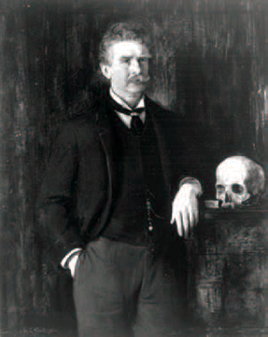
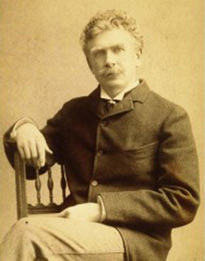
Ambrose Bierce settled in San Francisco in 1867, at age twenty-five, two years after leaving the Army. He had fought in numerous Civil War skirmishes and was severely injured at Kennasaw Mountain. In San Francisco, Bierce found work at the mint and spent much of his spare time reading classic literature. By the next year he was writing for the Golden Era and the News Letter, of which he became editor. Bierce wrote for San Francisco-based publications for much of the next thirty years, with interludes in London and the Dakota Territory. He contributed thousands of columns, stories, sketches, criticism, and suites of definitions, which would become part of The Devil’s Dictionary. In 1887, by then a celebrity journalist, he began working for William Randolph Hearst at the San Francisco Examiner.
Bierce was poorly published in book form. His volume of stories, Tales of Soldiers and Civilians, published in 1892, containing, arguably, the finest literary writing to grow out of the Civil War, had a limited distribution. In 1906 Doubleday, Page published the first collection of Bierce’s definitions, titled The Cynic’s Word Book. Bierce’s Collected Works, in twelve volumes, began appearing in 1909. The editing as well as some of the writing was uneven, and the volumes were not widely available. In 1911, The Devil’s Dictionary appeared as the seventh volume of Bierce’s Collected Works.
Bierce disappeared in 1913, his last post sent the day after Christmas from Chihuahua, Mexico. Now, nearly a century later, as Ambrose Bierce celebrates his 169th birthday in an unknown location, The Library of America has published an 880-page volume of his work, and Kelly’s Cove Press publishes The Best of the Devil’s Dictionary, and Civil War Stories.